The Unseen Force: Axial Support in Pumps & Compressors
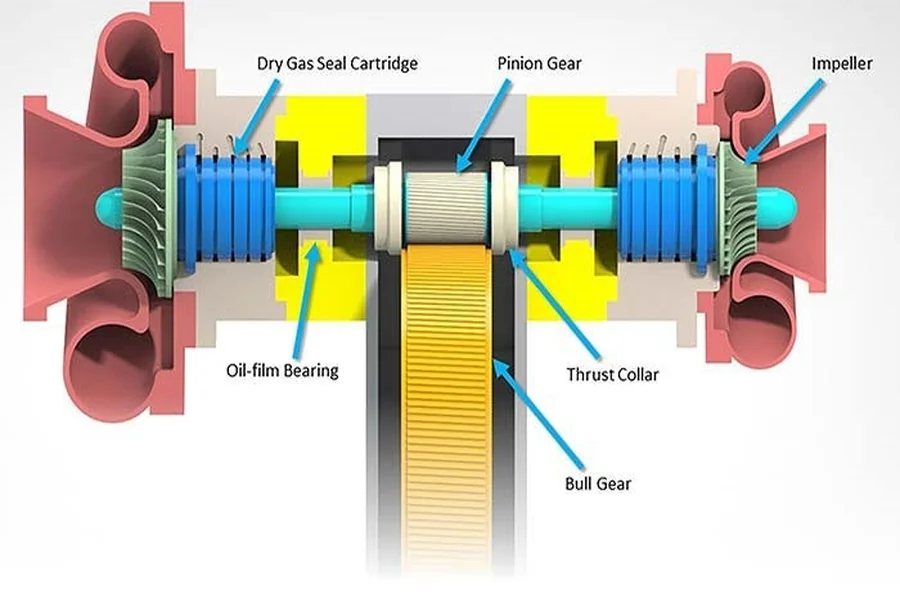
Pumps and compressors are the workhorses of countless industries, from oil and gas to manufacturing and water treatment. They move fluids and gases, making modern processes possible. While we often focus on the motors and impellers that drive these machines, there’s a critical set of components working tirelessly behind the scenes: axial support elements.
What Are Axial Support Elements?
In any pump or compressor, the rotating assembly (the shaft, impellers, or rotors) is subjected to various forces. Axial forces, or thrust, are forces that act parallel to the shaft’s axis of rotation. These are generated by pressure differences across the impellers and other aerodynamic or hydrodynamic effects.
Axial support elements are designed to absorb and counteract these thrust loads. They ensure the rotating assembly stays in its correct axial position, preventing contact between rotating and stationary parts. By managing these forces, they protect the machine’s internal components, maintain operational efficiency, and extend its service life.
Common Types of Axial Support Elements
There are several methods and devices used to manage axial thrust in pumps and compressors. The choice depends on the magnitude of the forces, the operating speed, the type of machine, and the process fluid.
Balance Drums and Pistons
A common and effective method for counteracting axial thrust is the use of a balance drum or balance piston.
- How it works: A balance drum is a cylindrical sleeve attached to the rotor. A corresponding stationary component creates a chamber that is connected to a region of different pressure—often the pump’s suction side. The pressure difference acting on the face of the drum creates a force that opposes the primary axial thrust generated by the impellers. The size of the drum is carefully calculated to offset the majority of the expected thrust.
- Applications: Balance drums are frequently used in multistage centrifugal pumps and compressors where axial forces can be substantial. They are highly reliable because they are a non-contact, hydraulic/aerodynamic solution.
Opposed Impellers
In some multistage pump designs, the layout of the impellers themselves can be used to manage axial thrust.
- How it works: Instead of having all impellers facing the same direction, they can be arranged in opposing groups. For example, in an eight-stage pump, the first four impellers might face one direction, while the last four face the opposite way. The thrust generated by the first group is largely canceled out by the thrust from the second group.
- Applications: This design is common in high-pressure, multistage pumps like those used for boiler feedwater or in pipelines. While it’s an elegant solution, it often results in more complex casing designs and internal passages.
Addressing Residual Thrust
While balance drums and opposed impellers handle the bulk of the axial load, there is almost always a residual thrust that needs to be managed. This is where thrust bearings come in. They are designed specifically to handle axial loads and precisely position the rotor.
- Tapered Roller Bearings: These bearings use conical rollers and raceways. Their angled design allows them to handle both radial and axial loads simultaneously. They are often used in pairs to handle thrust in both directions and are common in smaller, more compact machinery.
- Tilting Pad Bearings: For high-speed and high-load applications, tilting pad thrust bearings are the standard. These consist of a series of pads (or shoes) that are free to tilt. As the shaft rotates, it drags a wedge of lubricating oil between itself and the pads. This hydrodynamic oil film supports the axial load. The tilting action allows the pads to adjust to changing loads and alignments, making them extremely robust and stable.
- Magnetic Bearings: An advanced solution involves using magnetic forces to levitate the rotor. Active magnetic bearings (AMBs) use electromagnets and a sophisticated control system to continuously monitor and adjust the rotor’s position. They can counteract axial forces with zero friction or wear. Though expensive, they are ideal for critical applications requiring oil-free operation, such as in a dry electromagnetic separator, or in high-speed compressors where efficiency is paramount.
The Importance of Proper Axial Support
Effective axial support is not just a feature; it’s a fundamental requirement for the reliable operation of pumps and compressors.
- Prevents Component Damage: Unchecked axial forces will push the rotor into stationary components, causing severe damage to impellers, casings, and seals. This can lead to immediate and catastrophic failure.
- Increases Efficiency: By maintaining precise internal clearances, proper axial support ensures the machine operates at its designed efficiency. Excessive movement can lead to internal leakage, reducing output and wasting energy.
- Extends Machine Lifespan: By managing thrust loads, axial support elements reduce stress and wear on all machine components, leading to a longer operational life and fewer breakdowns.
- Enhances Reliability: A well-designed axial support system makes the machine more robust and tolerant of varying operating conditions. This translates to higher reliability and more uptime for the entire process.
Maintenance and Troubleshooting
Like any critical component, axial support elements require regular attention to ensure they perform correctly.
Maintenance Best Practices
- Lubrication Monitoring: For oil-lubricated bearings, proper lubrication is everything. Regularly check oil levels, quality, and temperature. Analyze oil samples for signs of contamination or degradation.
- Temperature Monitoring: High bearing temperatures are a primary indicator of a problem. Use embedded temperature sensors (like RTDs or thermocouples) to continuously monitor thrust bearing temperatures and set alarms for high-temperature conditions.
- Vibration Analysis: Regular vibration monitoring can detect early signs of bearing wear, misalignment, or imbalance. Changes in the axial vibration signature can indicate a developing thrust problem.
- Clearance Checks: During planned shutdowns, inspect axial clearances to ensure they are within the manufacturer’s specifications. For tilting pad bearings, check the condition of the pads and the oil film.
Common Issues and Solutions
- Overheating Bearings: This can be caused by insufficient or contaminated lubrication, excessive load, or misalignment. The first step is to verify the lubrication system is functioning correctly. If the problem persists, the machine may need to be shut down for inspection.
- Increased Axial Vibration: This could signal a failing bearing or a sudden change in process conditions that has altered the axial thrust. Cross-check with process data to see if operating parameters have changed.
- Wear on Thrust Components: Visible wear on balance drums or bearing surfaces indicates a systemic problem. This could be due to process upsets creating higher-than-design thrust or a failure in the support system itself. A full inspection and root cause analysis are necessary.
Conclusion
Axial support elements may not be the most glamorous parts of a pump or compressor, but they are undeniably among the most important. They are the silent guardians that absorb immense forces, ensuring the machine’s rotating heart can perform its job without destroying itself.



Post Comment
You must be logged in to post a comment.